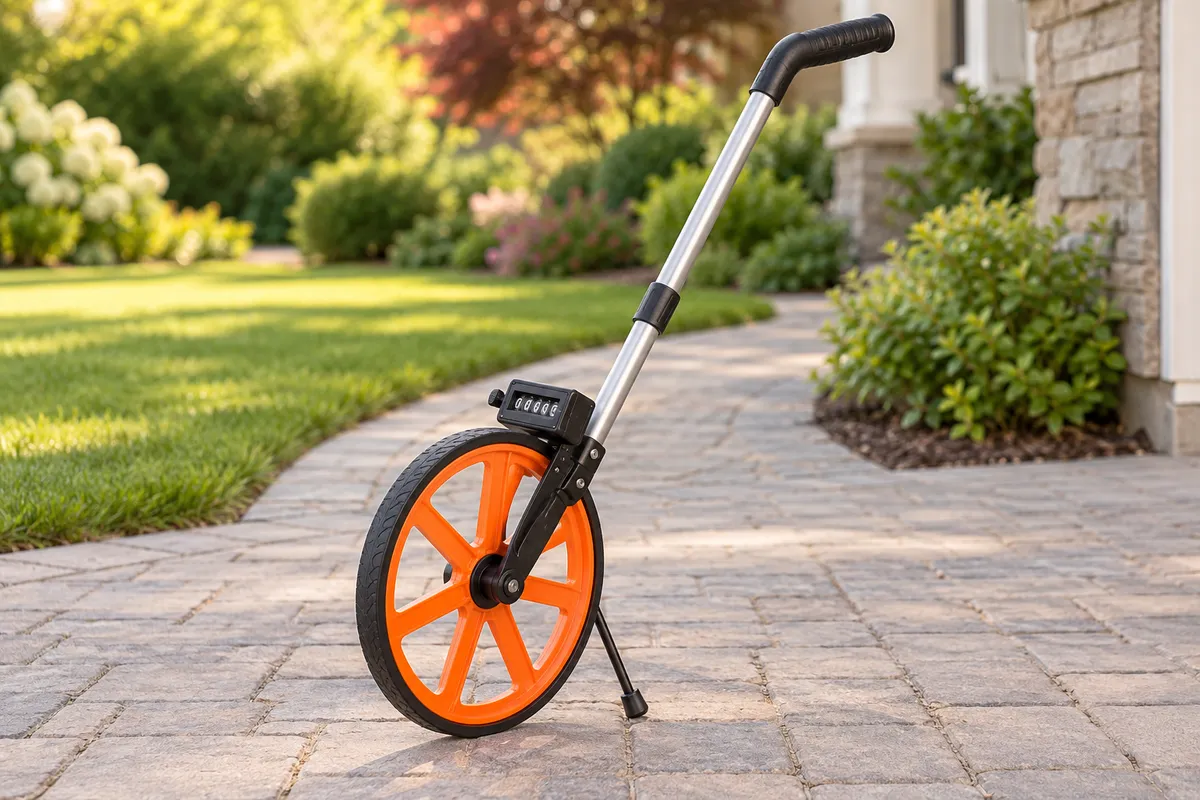
A REPEATABLE METHOD
How to use it
- Choose safe start and end marks; confirm the counter units and reset to zero.
- Check the wheel on a known reference length before the job.
- Roll steadily along the intended route with continuous ground contact.
- Record each segment, surface and any interruptions; follow the model instructions for wall-end offsets.
- Repeat the run and investigate disagreement before using the estimate.
INTERPRET THE MEASUREMENT
How to read the result
- The counter follows the surface route, including curves and rises; it is not a horizontal map distance.
- Slipping, bouncing, mud and a wandering route can change the result.
- Extra display digits do not make a rough-ground estimate suitable for precision setting-out.
Work through an example
Illustrative situations and readings, not product tolerances. Follow the instructions for your own tool.
Keep route segments separate from a detourOpen the worked exampleClose the worked example
Estimate a safe garden path in three accessible segments. The wheel follows the ground route, not a surveyed horizontal distance.
Before you start
- Mark the segment endpoints and confirm the counter units and zero.
- Follow the intended route with ground contact; do not include a detour around an obstacle.
- Repeat the route and note ground conditions and interruptions.
Example notes
- Segments on first run
- 8.4 + 6.2 + 3.1 m
- First total
- 17.7 m
- Repeated total
- 17.9 m
What this tells you
The totals differ by 0.2 m. They are preliminary route estimates, not guaranteed bounds on the true length. Check the route and surface before selecting a final planning value.
Your next step
Record each segment and the reason for any interruption. Use a more suitable method when the required precision exceeds the wheel-and-surface result.
Do not conclude: Do not turn this estimate into a legal boundary, a numeric drainage slope or permission to excavate.
Method reference: Bosch: measuring wheel and counter
TROUBLESHOOT THE METHOD
Common problems and what to check
Repeated runs disagree
Check the same endpoints and route, wheel cleanliness, units and reference-length result.
An obstacle breaks the route
Measure separately accessible segments and label the interruption; do not count a detour as the intended route.
STOP BEFORE THE HAZARD
Safety boundary
- Do not enter traffic, open excavations or unstable ground to keep the wheel rolling.
- A measured route is not permission to dig: locate services and obtain the required approvals first.
- Keep this estimate separate from legal boundary surveys and safety-critical construction dimensions.
SMART BUYING GUIDE
What to look for when choosing
- Match wheel size to the surface and check the stated units.
- Try the handle, reset, brake and readability; check how reverse movement is counted.
Types of tool
Best for: Smooth accessible floors and short routes.
Best for: Longer accessible outdoor routes, with surface-related uncertainty.
Common functions
Worth paying more for
- A readable counter, reliable reset and stable handle suited to the ground.
Usually not worth the extra cost
- Extra precision claims that ignore the actual surface and route.
Sources & instructions
- Keson: measuring-wheel limitations and surface distance
- Bosch Professional: measuring-wheel construction and units
AI-generated topic illustration; do not use the depicted scale for measurements.
Put the measurements to work
Estimate spoil while keeping utilities, collapse protection, water and access as separate decisions.
Turn roof runoff into a buildable drainage set-outCarry a design rainfall from the connected roof area through outlet capacity, gutter fall, overflow and final discharge.